Testing Floating solar farms in wind and waves
Testing the next generation floating wind turbines
Scalewind JIP
Working closely with its Scalewind JIP partners, MARIN aims to develop robust, validated procedures, models, and datasets for both numerical and experimental assessments of fully integrated FOWT systems. marin.nl/jips/scalewind
Rink Hallman
Senior Project Manager Defence
“It was a great challenge to develop this new wind setup, and thereby ensure that FOWT, solar, and traditional offshore customers are optimally served.”

“BlueLabs brings our vision of an integrated maritime energy transition to life, with innovations in sustainable energy, fuel logistics, and zero-emission shipping.”
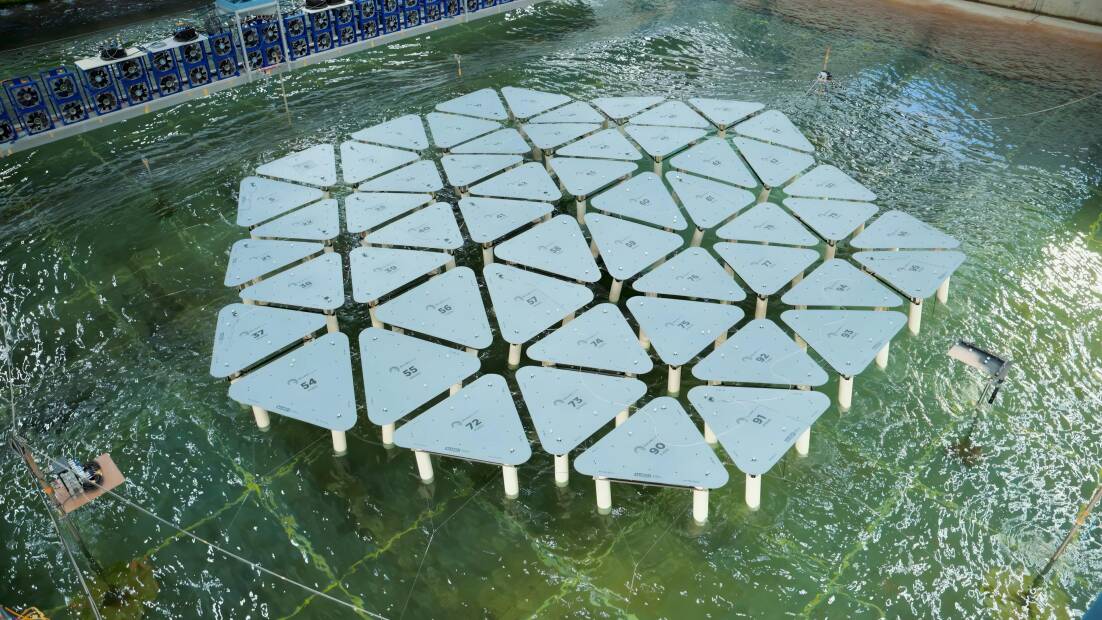
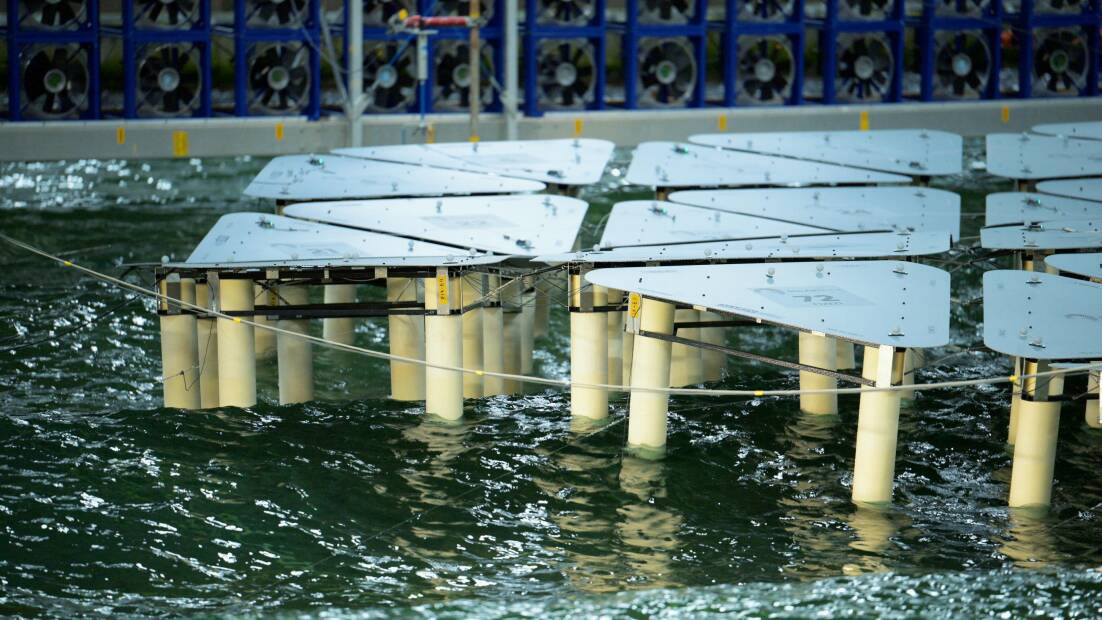
Floating solar farms are widely seen as a promising addition to the offshore energy mix. By placing photovoltaic systems on water, developers can unlock vast new areas for energy generation while benefiting from natural cooling effects that improve panel efficiency.
However, the drive for efficiency comes with tradeoffs. Designers aim to maximise the number of solar panels, while minimising the amount of structural material required. This leads to lighter, more flexible platforms—structures that can be particularly sensitive to environmental forces, especially wind.
From recent projects, MARIN has learned that the effect of wind and waves cannot be considered separately from each other but must be tested together to capture the true dynamic response. The BlueLabs testing facility will provide valuable new insights into these interesting but complex physics.
August 2026, no. 148
Create a MARIN account to stay updated

Report
Haite van der Schaaf
Senior Project Manager BlueLabs
“It’s great to see how the efforts of a large multidisciplinary engineering team result in the BlueLabs systems working seamlessly together, delivering strong growth in functional capabilities.”
Interested? Contact us to discuss your options
Important next step in testing renewables
As well as providing support to the offshore industry in design verification and innovation, the new test facility is expected to play an important role in the validation of multi-fidelity simulation methods that are being used in the innovation, design and optimisation of renewable energy systems.
With bigger wind generation systems, future renewable projects such as large-scale FOWT systems and floating solar farms can be tested in combined environmental conditions, i.e. in multi-directional waves, currents and high-quality wind. As such these developments are an important next step in laboratory testing to provide reliable advice and first-class data to the offshore renewable industry.
Along with the wind generation system, MARIN developed a new stock wind turbine model to mimic a 22MW turbine at scale 1:47.5, which results in a 6m rotor scale diameter. Additionally, a wireless measurement system was developed (see Report magazine 141/wireless-setup).
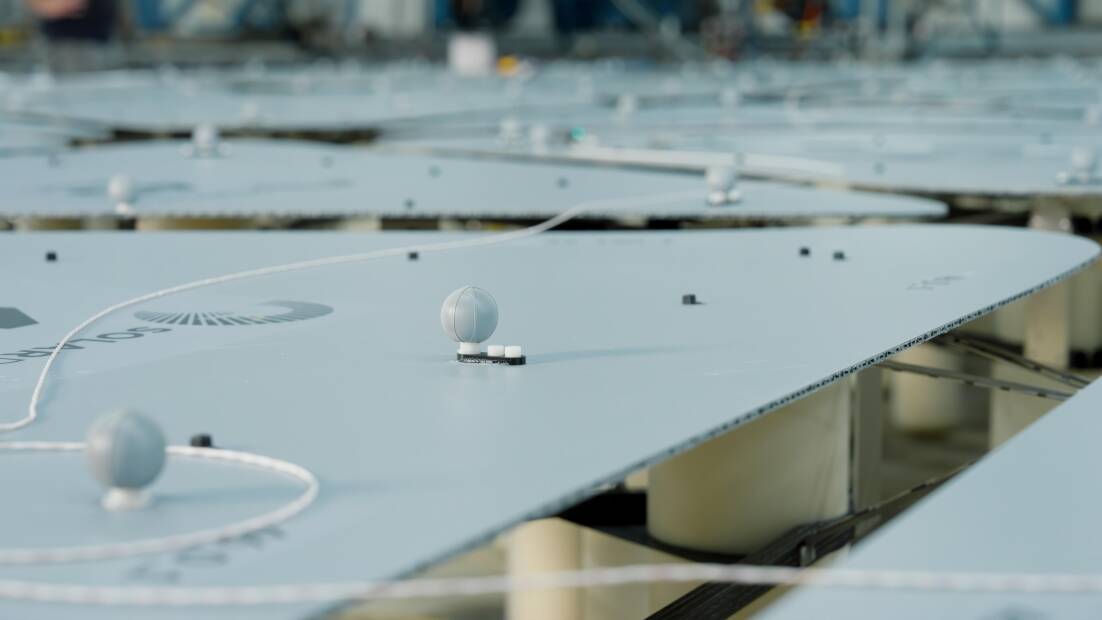
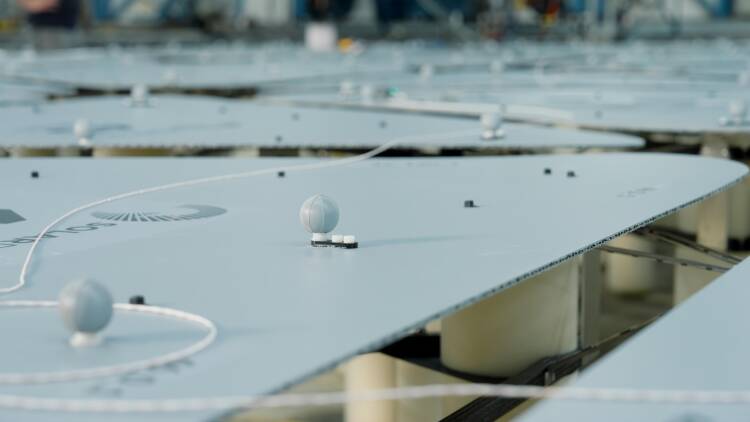
As renewable energy systems are relatively lightweight, the use of electrical measurement cables should be avoided as much as possible to prevent these cables influencing the platform motions. Therefore, the models can be equipped with small transducer units consisting of a battery and wireless data transfer to avoid the use of these measurement cables.
Furthermore, to be able to measure the motions of floating solar farms and floating infrastructure consisting of multiple objects spread out over a large space, a new optical measurement system is being developed.
Large-scale floating solar farms and next generation turbines
Within this test facility, large-scale, lightweight floating solar energy farms and the next generation of floating wind turbines of 20MW+ can be tested in combined wind, waves and current conditions. For this purpose, a new modular wind generation system was developed alongside a wireless measurement system, an optical motion tracking system, and a dedicated stock model for these 20MW+ wind turbines.
The wind generation system consists of modular wind tunnel units including a fan, contraction nozzle, honeycombs and flow conditioners to generate a wind field of high homogeneity and low turbulence. Due to its modular units, the system can be built up to generate a 18m x 3.4m wind field to test large-scale floating solar energy farms and floating offshore infrastructure. Alternatively, the wind field generation system can be transformed to a 9m x 6.8m setup to be able to test 20MW+ floating wind turbines at scale 1:40-50, instead of 1:70-80 in the original setup. The fans that generate the wind can be individually controlled such that time-dependent wind spectra can be generated, as well as a variation of the wind velocity over height to mimic the atmospheric boundary layer observed offshore.
As part of the Scalewind Joint Industry Project, BlueLabs was used for the first time to test a semisubmersible floating offshore wind turbine (FOWT). This milestone marks a significant step towards advancing the design and validation of nextgeneration floating wind technology.
To meet ever-increasing renewable energy demands, floating offshore wind turbines and floating solar energy farms are increasing in size. As a result, the complex demands on controlled laboratory tests move beyond the current state-of-the-art wave basin facilities. To support this trend, MARIN developed an advanced test laboratory to upgrade its existing Offshore Basin.
This spring MARIN proudly opened BlueLabs, its unique facility for testing the next generation of floating offshore wind turbines and floating solar.
First project for BlueLabs - MARIN’s specialist floating energy facility
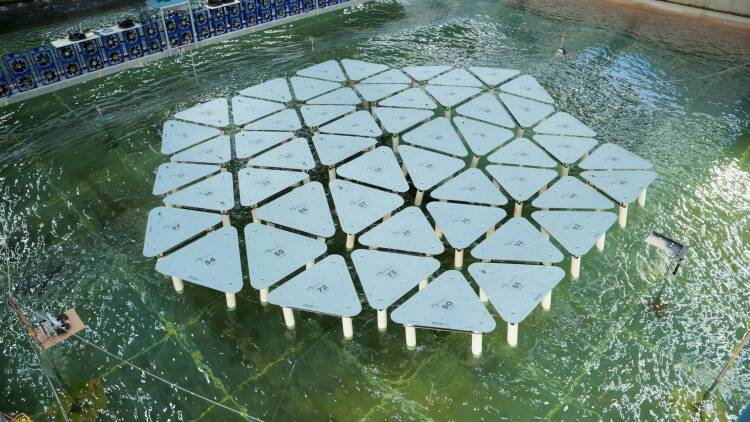
Testing large-scale floating solar farms
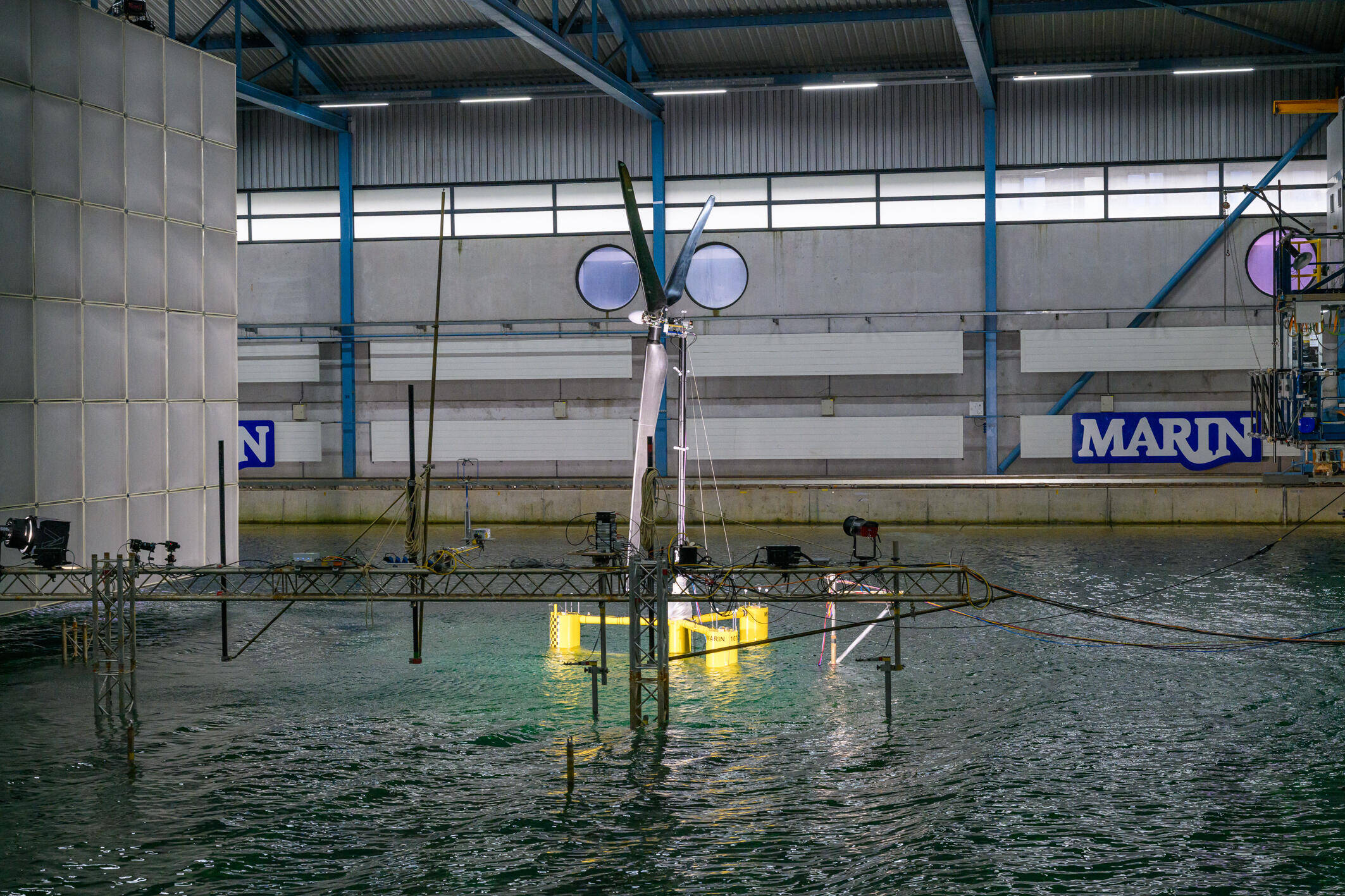
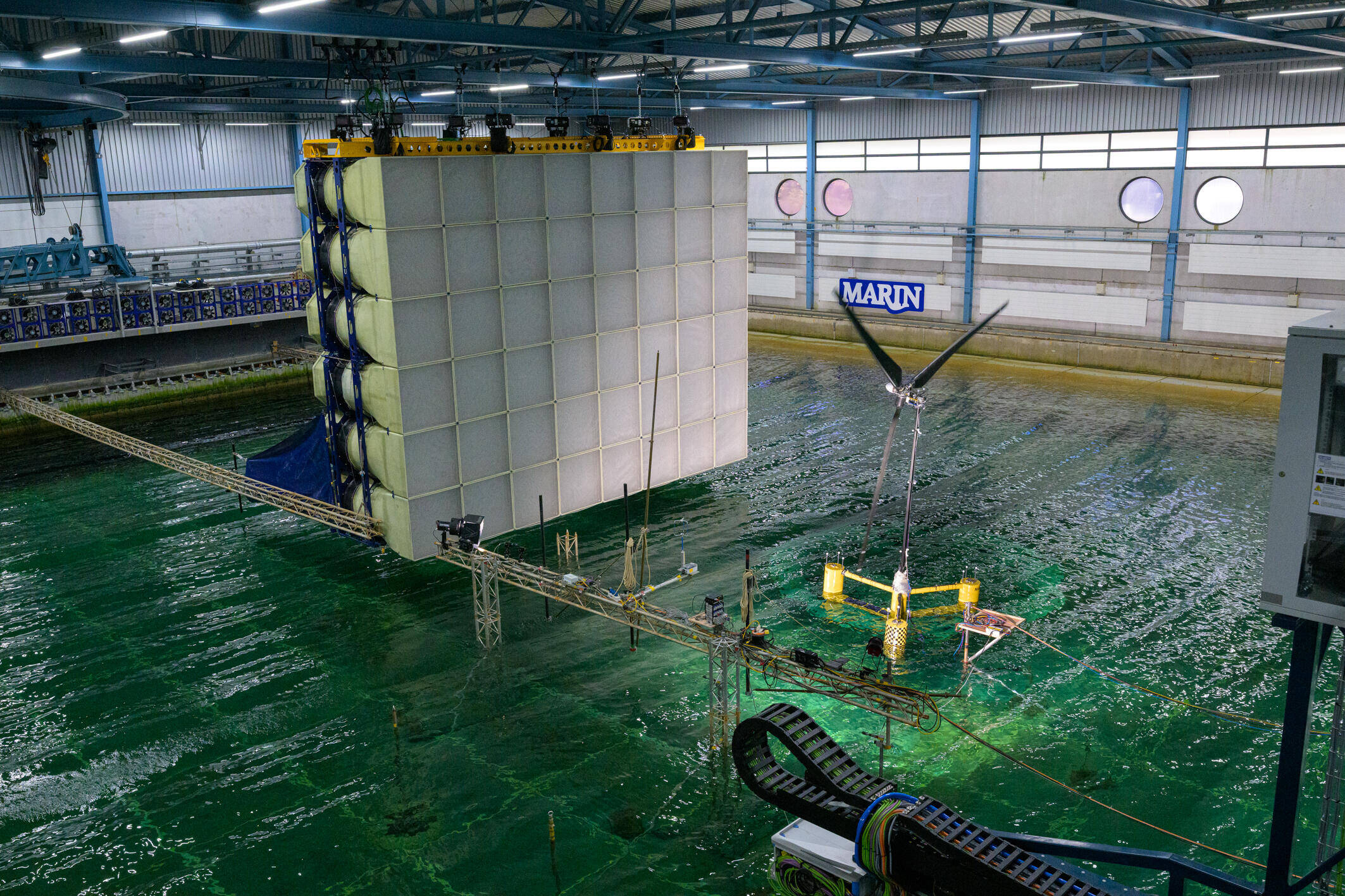
Scalewind JIP floater in the new BlueLabs setup



Testing Floating solar farms in wind and waves
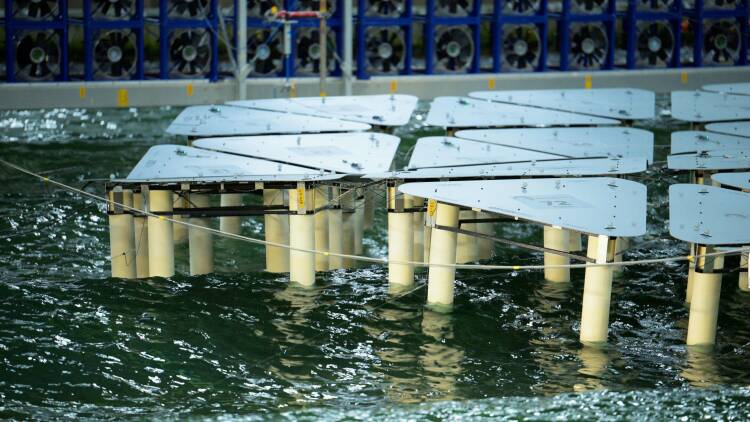
Floating solar farms are widely seen as a promising addition to the offshore energy mix. By placing photovoltaic systems on water, developers can unlock vast new areas for energy generation while benefiting from natural cooling effects that improve panel efficiency.
However, the drive for efficiency comes with tradeoffs. Designers aim to maximise the number of solar panels, while minimising the amount of structural material required. This leads to lighter, more flexible platforms—structures that can be particularly sensitive to environmental forces, especially wind.
From recent projects, MARIN has learned that the effect of wind and waves cannot be considered separately from each other but must be tested together to capture the true dynamic response. The BlueLabs testing facility will provide valuable new insights into these interesting but complex physics.
Testing large-scale floating solar farms
“BlueLabs brings our vision of an integrated maritime energy transition to life, with innovations in sustainable energy, fuel logistics, and zero-emission shipping.”
Important next step in testing renewables
As well as providing support to the offshore industry in design verification and innovation, the new test facility is expected to play an important role in the validation of multi-fidelity simulation methods that are being used in the innovation, design and optimisation of renewable energy systems.
With bigger wind generation systems, future renewable projects such as large-scale FOWT systems and floating solar farms can be tested in combined environmental conditions, i.e. in multi-directional waves, currents and high-quality wind. As such these developments are an important next step in laboratory testing to provide reliable advice and first-class data to the offshore renewable industry.
Scalewind JIP
Working closely with its Scalewind JIP partners, MARIN aims to develop robust, validated procedures, models, and datasets for both numerical and experimental assessments of fully integrated FOWT systems. marin.nl/jips/scalewind
Rink Hallman
Senior Project Manager Defence
“It was a great challenge to develop this new wind setup, and thereby ensure that FOWT, solar, and traditional offshore customers are optimally served.”
Along with the wind generation system, MARIN developed a new stock wind turbine model to mimic a 22MW turbine at scale 1:47.5, which results in a 6m rotor scale diameter. Additionally, a wireless measurement system was developed (see Report magazine 141/wireless-setup).
As renewable energy systems are relatively lightweight, the use of electrical measurement cables should be avoided as much as possible to prevent these cables influencing the platform motions. Therefore, the models can be equipped with small transducer units consisting of a battery and wireless data transfer to avoid the use of these measurement cables.
Furthermore, to be able to measure the motions of floating solar farms and floating infrastructure consisting of multiple objects spread out over a large space, a new optical measurement system is being developed.
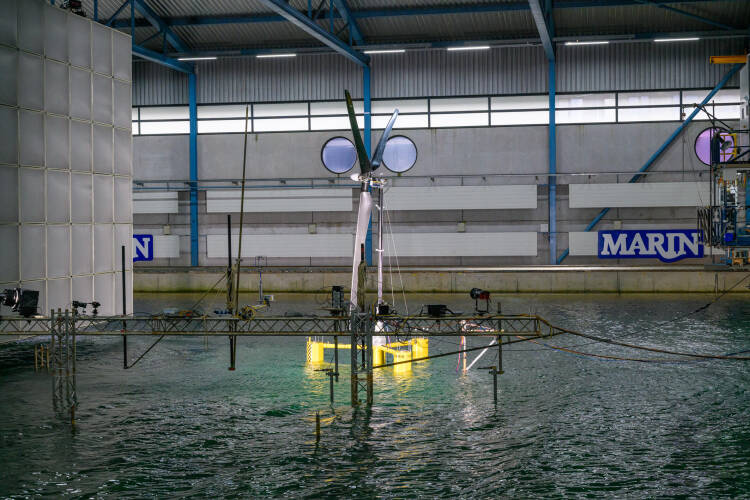
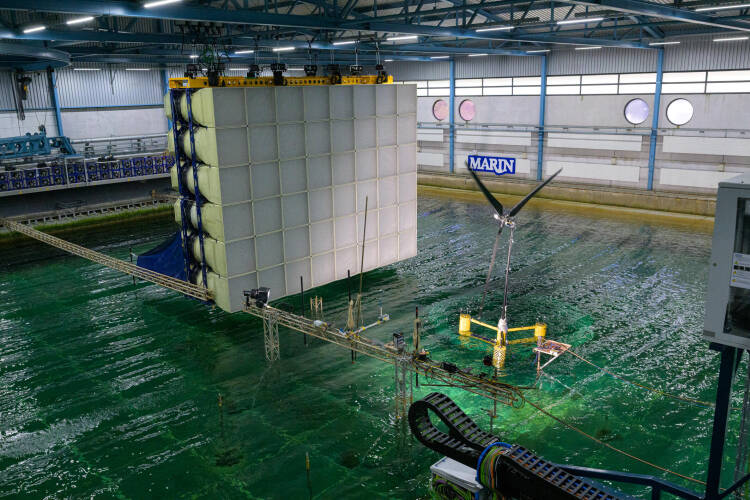
Scalewind JIP floater in the new BlueLabs setup
Testing the next generation floating wind turbines
Large-scale floating solar farms and next generation turbines
Within this test facility, large-scale, lightweight floating solar energy farms and the next generation of floating wind turbines of 20MW+ can be tested in combined wind, waves and current conditions. For this purpose, a new modular wind generation system was developed alongside a wireless measurement system, an optical motion tracking system, and a dedicated stock model for these 20MW+ wind turbines.
The wind generation system consists of modular wind tunnel units including a fan, contraction nozzle, honeycombs and flow conditioners to generate a wind field of high homogeneity and low turbulence. Due to its modular units, the system can be built up to generate a 18m x 3.4m wind field to test large-scale floating solar energy farms and floating offshore infrastructure. Alternatively, the wind field generation system can be transformed to a 9m x 6.8m setup to be able to test 20MW+ floating wind turbines at scale 1:40-50, instead of 1:70-80 in the original setup. The fans that generate the wind can be individually controlled such that time-dependent wind spectra can be generated, as well as a variation of the wind velocity over height to mimic the atmospheric boundary layer observed offshore.
As part of the Scalewind Joint Industry Project, BlueLabs was used for the first time to test a semisubmersible floating offshore wind turbine (FOWT). This milestone marks a significant step towards advancing the design and validation of nextgeneration floating wind technology.
To meet ever-increasing renewable energy demands, floating offshore wind turbines and floating solar energy farms are increasing in size. As a result, the complex demands on controlled laboratory tests move beyond the current state-of-the-art wave basin facilities. To support this trend, MARIN developed an advanced test laboratory to upgrade its existing Offshore Basin.
August 2026, no. 148
Haite van der Schaaf
Senior Project Manager BlueLabs
“It’s great to see how the efforts of a large multidisciplinary engineering team result in the BlueLabs systems working seamlessly together, delivering strong growth in functional capabilities.”
This spring MARIN proudly opened BlueLabs, its unique facility for testing the next generation of floating offshore wind turbines and floating solar.
First project for BlueLabs - MARIN’s specialist floating energy facility
Interested? Contact us to discuss your options

Erik-Jan de Ridder
Senior Project Manager Offshore


Create a MARIN account to stay updated

Report


