

The work was carried out as part of the MAGPIE project, funded by the European Union’s Horizon 2020 research and innovation programme under grant agreement No. 774253. magpie-ports.eu
More info
Extended abstract (as presented at DeWaTra 2026) : Real-time simulation for feasibility assessment of a charging station in the North Sea.





“The MAGPIE E-Tower demonstration provided a great opportunity to test upfront the marine operation and the approach of the E-Tower in a safe and reliable manner. The MARIN virtual reality and full mission bridge simulations are very helpful for us. You can do a lot of simulations in a short time and can adjust to what is being learned.”

Evert-Han Huernink
Tender Manager, Bluewater
MAGPIE WP5 Demo E-Tower Simulations.
Three-day simulation campaign
To assess the feasibility and operational limits of the offshore E-Tower solution, MARIN conducted an extensive three-day simulation campaign at the Seven Oceans Simulation centre. The eSOV (electric Service Operation Vessel) bridge was placed on MARIN’s Large Motion Simulator, allowing captains to experience realistic vessel motions while manoeuvring towards the E-Tower.
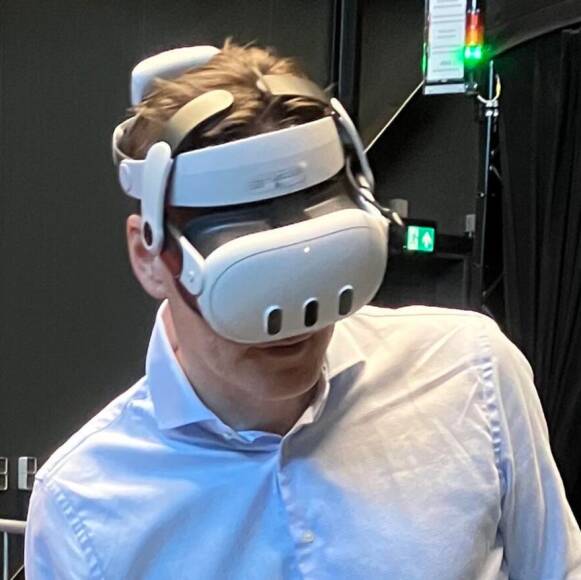
For deck operations, MARIN deployed a mixedreality VR setup that placed a deckhand virtually on the bow of the vessel. The deckhand, visible as an avatar to the captain, guided alignment, messenger line handling, and connection procedures. The overall evaluation covered all critical aspects of the marine operation, such as weather limits, motion response, approach manoeuvres, mooring on the hawser, departure operations, communication, human factors and crew comfort.
Create a MARIN account to stay updated

Report
August 2026, no. 148
Interested? Contact us to discuss your options
Confirmation of feasibility of safe and reliable marine operations
The results of the extensive simulation campaign confirmed that the E-Tower solution is well suited to the challenging shallow-water offshore conditions of the Dutch North Sea, a key requirement for the further integration of the technology with offshore wind infrastructure.
The campaign demonstrated that the available thruster power of the studied vessel was sufficient to perform controlled and safe manoeuvres in rough North Sea conditions, including wind speeds of up to 12.9 m/s and combined wave heights of 2.5 m. It was also shown that all critical operations could be safely executed from the mooring deck, which is largely sheltered from environmental exposure, under these conditions. Performing the same tasks from the exposed top deck became more challenging due to the high wind speeds. Under harsher conditions, with wind speeds of 20 m/s and a total sea height of 3.5 m, operations became challenging even from the mooring deck. Crew comfort was also identified as a limiting factor, with equivalent sea heights above approximately 2.5 m notably affecting working conditions.
Recharged and Ready: MAGPIE’s E‑Tower demonstration paves the way for clean, battery‑powered ships
“The MAGPIE project is a perfect example of our ambition to realise an integrated maritime energy transition, bringing together innovations in sustainable energy production, fuel logistics, and zero-emission shipping.”

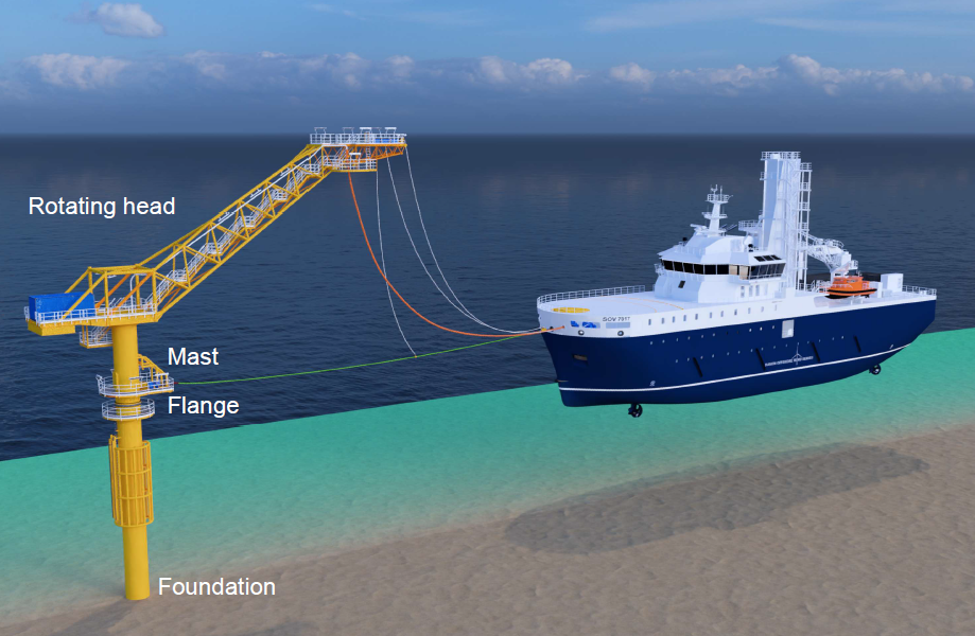
Visual representation of e-SOV connected to an E-Tower for charging (source: Bluewater).
Tackling a hidden source of maritime emissions
Although shipping is one of the most carbonefficient modes of transport, its absolute global emissions are not insignificant. Global shipping emits more than 850 million tonnes of CO₂ annually, and a surprisingly large share comes from vessels idling at anchor. At any moment, more than 6,000 ships are waiting outside ports worldwide, running auxiliary engines to power onboard systems. The E-Tower concept directly addresses this issue by enabling vessels to connect to clean offshore electric power, eliminating emissions during waiting times or offshore operations.
A major Horizon 2020 project, MAGPIE brings together ports, research institutes, and industry partners and aims to accelerate the development of smart, green, and low-emission ports by 2050 to support the Paris Agreement.
Developed by Bluewater, the offshore E-Tower is a mooring and charging concept, allowing vessels to shut down their engines and draw renewable electricity while waiting offshore. The virtual reality and full mission bridge demonstration was led by the MAGPIE consortium partners MARIN, Bluewater and Van Oord. MARIN’s role was to assess the feasibility and operational limits of the E-Tower concept in the Seven Oceans Simulator centre, combining full mission bridge simulations, motionbased training, and immersive virtual reality to replicate realworld offshore operations.
A major step has been achieved in the MAGPIE (sMArt Green Ports as Integrated Efficient multimodal hubs) project, showing how large vessels can safely connect to an offshore charging tower in typical shallow water North Sea conditions.
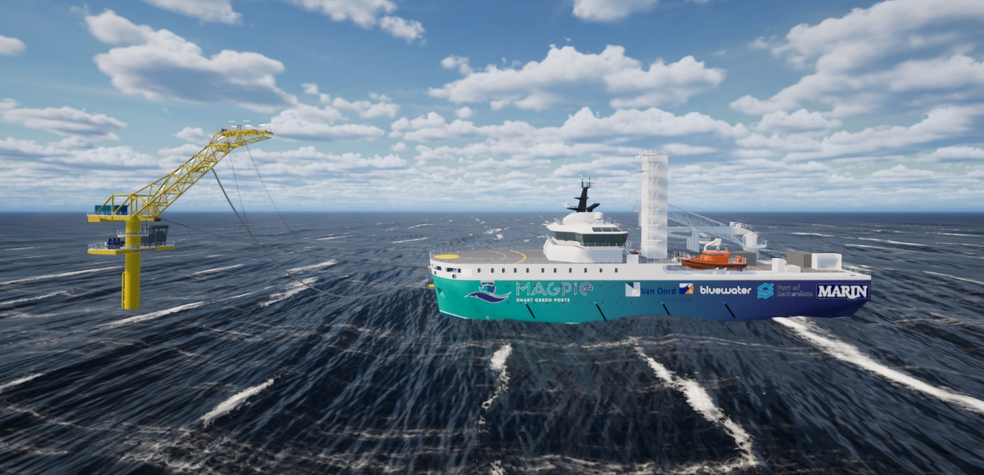
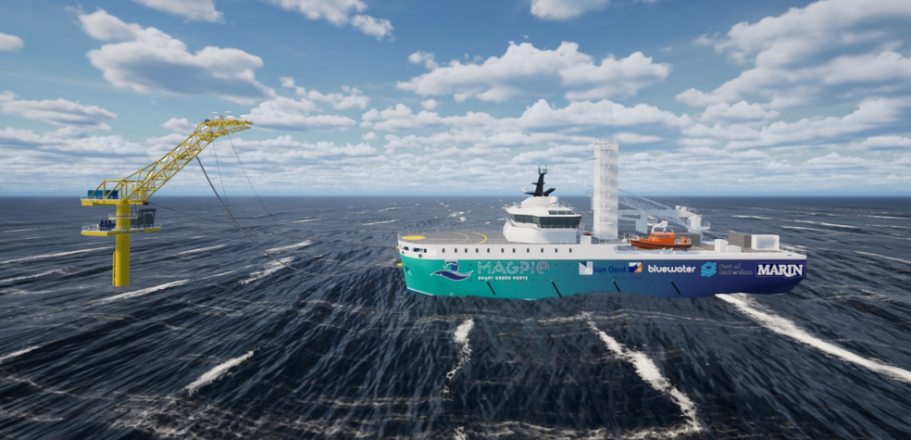
Visual representation of the operation.


MAGPIE WP5 Demo E-Tower Simulations.
Confirmation of feasibility of safe and reliable marine operations
The results of the extensive simulation campaign confirmed that the E-Tower solution is well suited to the challenging shallow-water offshore conditions of the Dutch North Sea, a key requirement for the further integration of the technology with offshore wind infrastructure.
The campaign demonstrated that the available thruster power of the studied vessel was sufficient to perform controlled and safe manoeuvres in rough North Sea conditions, including wind speeds of up to 12.9 m/s and combined wave heights of 2.5 m. It was also shown that all critical operations could be safely executed from the mooring deck, which is largely sheltered from environmental exposure, under these conditions. Performing the same tasks from the exposed top deck became more challenging due to the high wind speeds. Under harsher conditions, with wind speeds of 20 m/s and a total sea height of 3.5 m, operations became challenging even from the mooring deck. Crew comfort was also identified as a limiting factor, with equivalent sea heights above approximately 2.5 m notably affecting working conditions.
“The MAGPIE project is a perfect example of our ambition to realise an integrated maritime energy transition, bringing together innovations in sustainable energy production, fuel logistics, and zero-emission shipping.”
Three-day simulation campaign
To assess the feasibility and operational limits of the offshore E-Tower solution, MARIN conducted an extensive three-day simulation campaign at the Seven Oceans Simulation centre. The eSOV (electric Service Operation Vessel) bridge was placed on MARIN’s Large Motion Simulator, allowing captains to experience realistic vessel motions while manoeuvring towards the E-Tower.
For deck operations, MARIN deployed a mixedreality VR setup that placed a deckhand virtually on the bow of the vessel. The deckhand, visible as an avatar to the captain, guided alignment, messenger line handling, and connection procedures. The overall evaluation covered all critical aspects of the marine operation, such as weather limits, motion response, approach manoeuvres, mooring on the hawser, departure operations, communication, human factors and crew comfort.
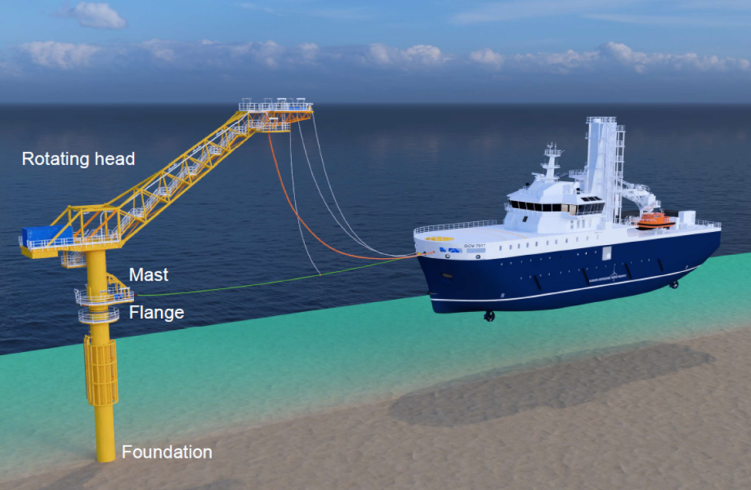
Visual representation of e-SOV connected to an E-Tower for charging (source: Bluewater).
Tackling a hidden source of maritime emissions
Although shipping is one of the most carbonefficient modes of transport, its absolute global emissions are not insignificant. Global shipping emits more than 850 million tonnes of CO₂ annually, and a surprisingly large share comes from vessels idling at anchor. At any moment, more than 6,000 ships are waiting outside ports worldwide, running auxiliary engines to power onboard systems. The E-Tower concept directly addresses this issue by enabling vessels to connect to clean offshore electric power, eliminating emissions during waiting times or offshore operations.
“The MAGPIE E-Tower demonstration provided a great opportunity to test upfront the marine operation and the approach of the E-Tower in a safe and reliable manner. The MARIN virtual reality and full mission bridge simulations are very helpful for us. You can do a lot of simulations in a short time and can adjust to what is being learned.”
Evert-Han Huernink
Tender Manager, Bluewater
Developed by Bluewater, the offshore E-Tower is a mooring and charging concept, allowing vessels to shut down their engines and draw renewable electricity while waiting offshore. The virtual reality and full mission bridge demonstration was led by the MAGPIE consortium partners MARIN, Bluewater and Van Oord. MARIN’s role was to assess the feasibility and operational limits of the E-Tower concept in the Seven Oceans Simulator centre, combining full mission bridge simulations, motionbased training, and immersive virtual reality to replicate realworld offshore operations.
A major Horizon 2020 project, MAGPIE brings together ports, research institutes, and industry partners and aims to accelerate the development of smart, green, and low-emission ports by 2050 to support the Paris Agreement.
The work was carried out as part of the MAGPIE project, funded by the European Union’s Horizon 2020 research and innovation programme under grant agreement No. 774253. magpie-ports.eu
Extended abstract (as presented at DeWaTra 2026) : Real-time simulation for feasibility assessment of a charging station in the North Sea.
More info
Interested? Contact us to discuss your options
Report
Visual representation of the operation.
August 2026, no. 148
The µMMS is not only applicable for FOWT, but also for other small floaters and ships. The new measurement system makes it possible to accurately test small vessels, without the unwanted effect of the measurement cables.
For example, this year the Dutch Ministry of Infrastructure and Water Management contracted MARIN to investigate the dynamics that are involved in the capsizing of beam trawlers. The main goal of this project was to investigate the capsize risk in relation to fishing operations and the stability criteria.
Initially, we had planned to make a free sailing model for the tests that connects to the measurement system on the carriage. The combination of a small vessel and the high wave height in the tests resulted in a model weight of less than 100 kg. Given the small model size, low forces can have an impact on the rolling behaviour of the vessel. Therefore, to minimise the impact that the cables can have on the motions of the vessel, we minimised the number of sensors on board to the bare minimum. Additionally, we planned to use thinner cables than normal to reduce the weight even further.
The µMMS became available when we were designing the model. This offered the opportunity to make the model completely wireless and to measure more signals within the budget of the project. Without the measurement wires between the carriage and the model, the test setup was more versatile. No precautions were necessary to avoid interference from the measurement cables.
A major step has been achieved in the MAGPIE (sMArt Green Ports as Integrated Efficient multimodal hubs) project, showing how large vessels can safely connect to an offshore charging tower in typical shallow water North Sea conditions.
Recharged and Ready: MAGPIE’s E‑Tower demonstration paves the way for clean, battery‑powered ships
Create a MARIN account to stay updated