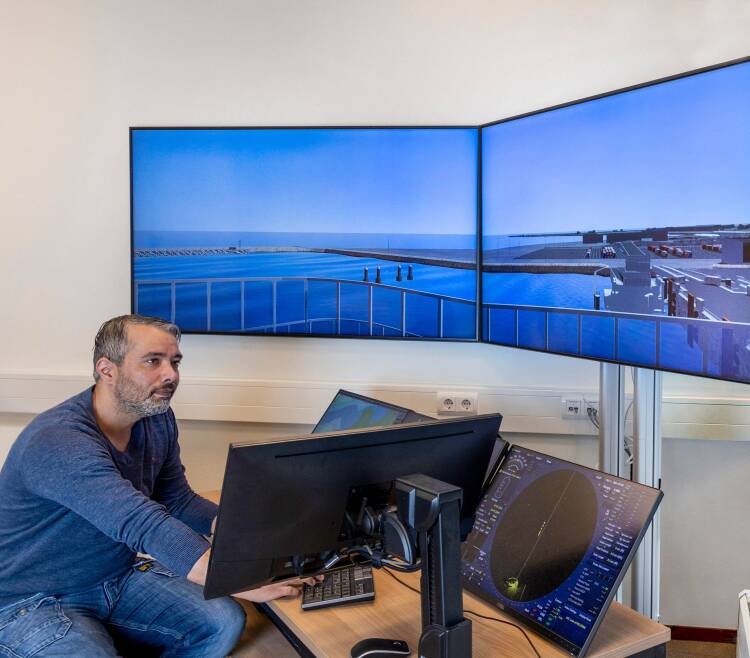
Simulator runs of the ferry entering and leaving the port of Calais.
Dennis Deighton
Project Engineer Analysis
“For creating the visuals of the ferry, a General Arrangement plan was used to obtain detailed info about dimensions, multiple views, hull markings, bollards, winches and colour schemes. A real-time simulation and visualisation software was then deployed for further processing. Shading, shadows, ship properties and ‘collision objects’ were added, together with extra files required for the simulations such as ship contours, bollard/winch positions, viewpoints and radar files.”

January 2026, no. 146
Create a MARIN account to stay updated

Report
Full-scale port manoeuvring simulations for Dover and Calais
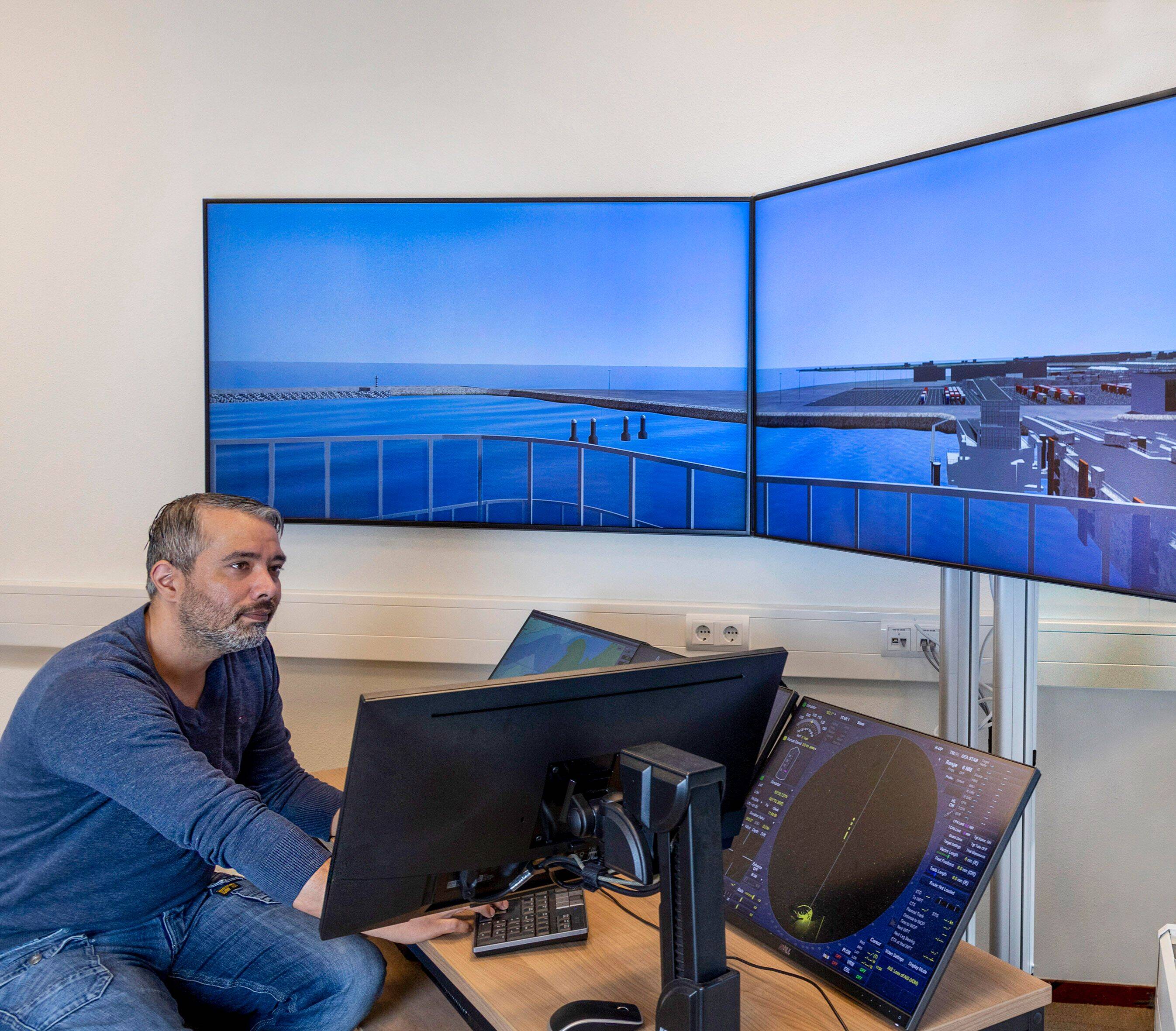
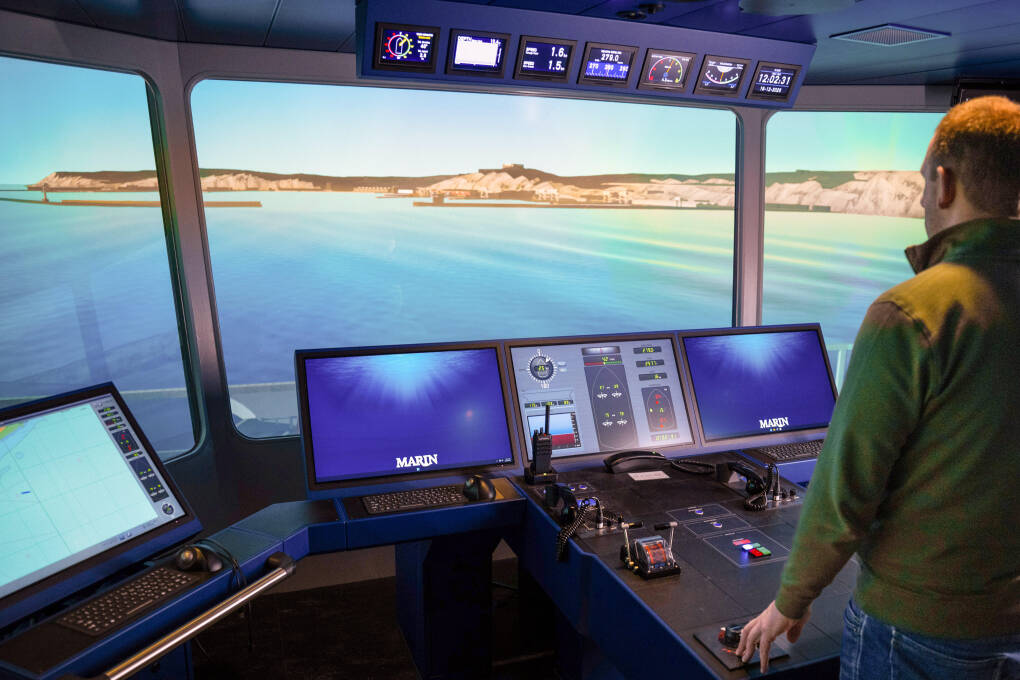
To test and verify the behaviour of the ferry in realistic conditions, two captains carried out various manoeuvres in a virtual environment on one of MARIN’s bridge simulators.
Captains carried out various manoeuvres in wind, waves and tidal conditions to familiarise them with the behaviour of the vessel.
Detailed geometry and realistic metocean conditions
The geometry of the area and the water depth were based on a recent electronic nautical chart (ENC) and drawings of the ports and terminals, while the visuals for the simulations were based on the drawings of the layout, information from Google Earth and pictures of the area. The modelled area covers the terminal and an adjacent part of the sea for the approach to the port. Features in the area associated with the navigation of vessels, such as navigational aids, specific buildings and cargo handling equipment, are represented in the database.
Realistic information on the metocean conditions in the approaches and the port is used for the simulations. Wind is uniform over most of the area but shielding from other vessels (moored or sailing) or by buildings and other constructions such as terminals has been accounted for. Temporal variations due to gusting are a standard feature. Tidal information about water levels and current patterns are included for a full tidal cycle. The most critical situations are those with strong crosscurrents in the harbour entrances.
Virtual trials
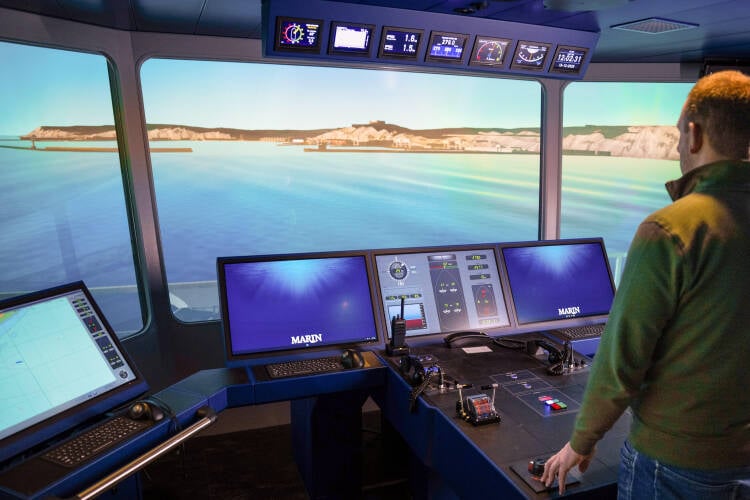
The simulations were carried out on MARIN’s Full Mission Bridge II. This facility has almost 360° visuals, 210° ahead and the astern view on a large monitor. To facilitate the berthing manoeuvre one extra monitor was installed on the simulator bridge to monitor the distance between the ferry and the quay during berthing.
A simulation programme of three days was sufficient to test a wide scope of conditions for both terminals (Calais and Dover). The programme included runs in average conditions to familiarise the captains with the behaviour of the vessel and runs in the most critical combinations of wind, waves and tidal conditions were tested during the simulations to find the limiting conditions for the ferry.
All runs were analysed individually and presented in track- and data plots showing characteristic parameters (speeds, pod power use, etc.) as a function of time. Conclusions focused on the controllability of the vessel under the limiting conditions. The simulations showed that the ferry is able to operate under all tidal conditions in combination with wind speeds of up to 20 m/s, and when using up to 70% of the available pod power.
Martijn Rodenburg, Mechanical Engineer at SolarDuck, highlighted one of the most promising findings: "Across all tests, we’ve observed that wind has a notable damping effect. As wind passes across the plant, platform motion visibly decreases. It’s great to see our expectations confirmed."
The campaign also included decay testing of individual platforms, offering insights into potential single-unit deployments for powering remote locations.
Berthing in crosswinds
When berthing in strong crosswind conditions the captains will frequently use the pods in the transverse direction. In these conditions the wash of one pod blows towards the other. This interaction between the pods, and between the pods and the ship’s hull, is included in the mathematical model of the ferry and is based on the results of the crabbing tests in deep and shallow water.
Apart from the manoeuvring behaviour of the ferry, derived from the model tests, the mechanical details of the pod propulsion are another vital element. As the ferry is sensitive to wind, it is important that the four controllable pods respond adequately to the settings the master chooses to respond to a gust. The turning rate of the pods and the ramp-up/down times of the propeller revolutions are of utmost importance in this respect and were implemented according to the specifications of the equipment.
These virtual trials were performed using a dedicated simulator database of the ports of Calais and Dover to determine the maximum environmental conditions under which the ferry can safely enter and berth at the ports.
To ensure that the virtual ferry reacts realistically to wind, waves and local current fields, we developed a mathematical manoeuvring model of the double-ended ferry based on the results of the free-sailing and captive manoeuvring tests as discussed in the previous article. This model, predicting the behaviour of the ferry in water depths ranging from deep to shallow water, was extended with parameters describing the wind forces and a 3D mock-up for the visuals.
Interested? Contact us to discuss your options
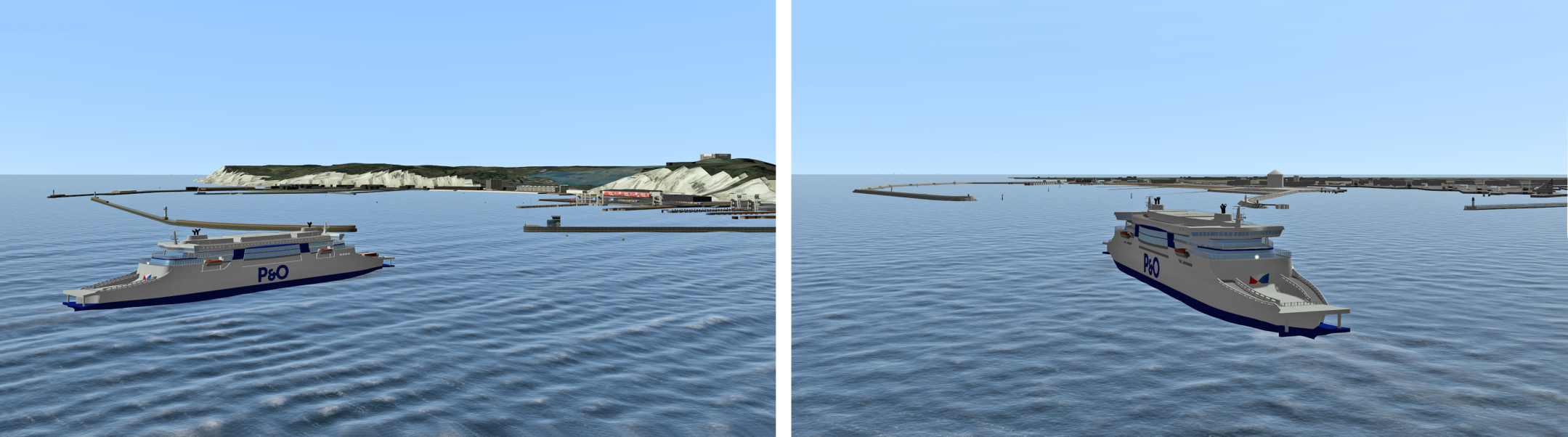
Visuals of Dover and Calais used for the real-time manoeuvring simulations.




Simulator runs of the ferry entering and leaving the port of Calais.
Dennis Deighton
Project Engineer Analysis
“For creating the visuals of the ferry, a General Arrangement plan was used to obtain detailed info about dimensions, multiple views, hull markings, bollards, winches and colour schemes. A real-time simulation and visualisation software was then deployed for further processing. Shading, shadows, ship properties and ‘collision objects’ were added, together with extra files required for the simulations such as ship contours, bollard/winch positions, viewpoints and radar files.”
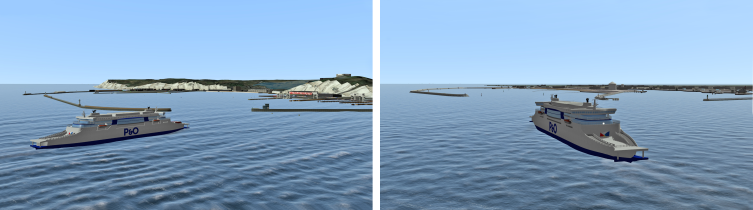
Visuals of Dover and Calais used for the real-time manoeuvring simulations.
January 2026, no. 146
Detailed geometry and realistic metocean conditions
The geometry of the area and the water depth were based on a recent electronic nautical chart (ENC) and drawings of the ports and terminals, while the visuals for the simulations were based on the drawings of the layout, information from Google Earth and pictures of the area. The modelled area covers the terminal and an adjacent part of the sea for the approach to the port. Features in the area associated with the navigation of vessels, such as navigational aids, specific buildings and cargo handling equipment, are represented in the database.
Realistic information on the metocean conditions in the approaches and the port is used for the simulations. Wind is uniform over most of the area but shielding from other vessels (moored or sailing) or by buildings and other constructions such as terminals has been accounted for. Temporal variations due to gusting are a standard feature. Tidal information about water levels and current patterns are included for a full tidal cycle. The most critical situations are those with strong crosscurrents in the harbour entrances.
Virtual trials
The simulations were carried out on MARIN’s Full Mission Bridge II. This facility has almost 360° visuals, 210° ahead and the astern view on a large monitor. To facilitate the berthing manoeuvre one extra monitor was installed on the simulator bridge to monitor the distance between the ferry and the quay during berthing.
A simulation programme of three days was sufficient to test a wide scope of conditions for both terminals (Calais and Dover). The programme included runs in average conditions to familiarise the captains with the behaviour of the vessel and runs in the most critical combinations of wind, waves and tidal conditions were tested during the simulations to find the limiting conditions for the ferry.
All runs were analysed individually and presented in track- and data plots showing characteristic parameters (speeds, pod power use, etc.) as a function of time. Conclusions focused on the controllability of the vessel under the limiting conditions. The simulations showed that the ferry is able to operate under all tidal conditions in combination with wind speeds of up to 20 m/s, and when using up to 70% of the available pod power.
Captains carried out various manoeuvres in wind, waves and tidal conditions to familiarise them with the behaviour of the vessel.
Berthing in crosswinds
When berthing in strong crosswind conditions the captains will frequently use the pods in the transverse direction. In these conditions the wash of one pod blows towards the other. This interaction between the pods, and between the pods and the ship’s hull, is included in the mathematical model of the ferry and is based on the results of the crabbing tests in deep and shallow water.
Apart from the manoeuvring behaviour of the ferry, derived from the model tests, the mechanical details of the pod propulsion are another vital element. As the ferry is sensitive to wind, it is important that the four controllable pods respond adequately to the settings the master chooses to respond to a gust. The turning rate of the pods and the ramp-up/down times of the propeller revolutions are of utmost importance in this respect and were implemented according to the specifications of the equipment.
These virtual trials were performed using a dedicated simulator database of the ports of Calais and Dover to determine the maximum environmental conditions under which the ferry can safely enter and berth at the ports.
To ensure that the virtual ferry reacts realistically to wind, waves and local current fields, we developed a mathematical manoeuvring model of the double-ended ferry based on the results of the free-sailing and captive manoeuvring tests as discussed in the previous article. This model, predicting the behaviour of the ferry in water depths ranging from deep to shallow water, was extended with parameters describing the wind forces and a 3D mock-up for the visuals.
To test and verify the behaviour of the ferry in realistic conditions, two captains carried out various manoeuvres in a virtual environment on one of MARIN’s bridge simulators.
Full-scale port manoeuvring simulations for Dover and Calais
Interested? Contact us to discuss your options

Create a MARIN account to stay updated

Report


