More info
https://needs.application.marin.nl

https://www.marin.nl/jips/needs
May 2026, no. 147


Interested? Contact us to discuss your options
Create a MARIN account to stay updated

Report
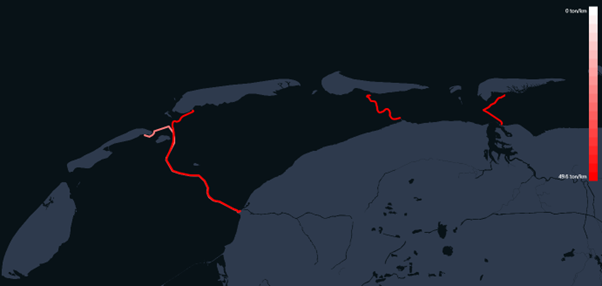
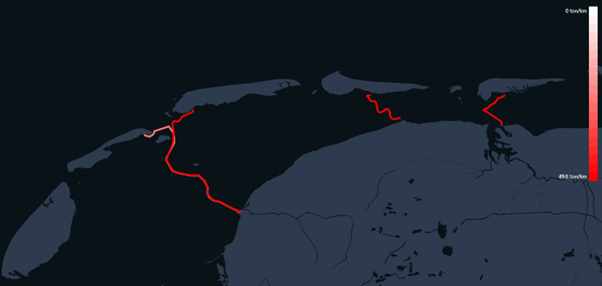
CO2 eq emissions distribution per route.
Retrofitting entire fleets to alternative propulsion systems presents challenges that go far beyond the propulsion system of a single ship.
What efforts are needed to upgrade the onshore electric grid to enable full fleet electrification? How does reducing service speed affect communities living on islands? These are just two of the questions shipowners and government bodies consider when addressing projects with such complex, multidisciplinary issues.
Techno-economic analysis of the Waddenzee
Since 2022, MARIN has been developing NEEDS, a dynamic techno-economic model designed to assist policymakers, shipowners, and national authorities in evaluating the impact of fleet retrofits on the entire waterborne transport system.
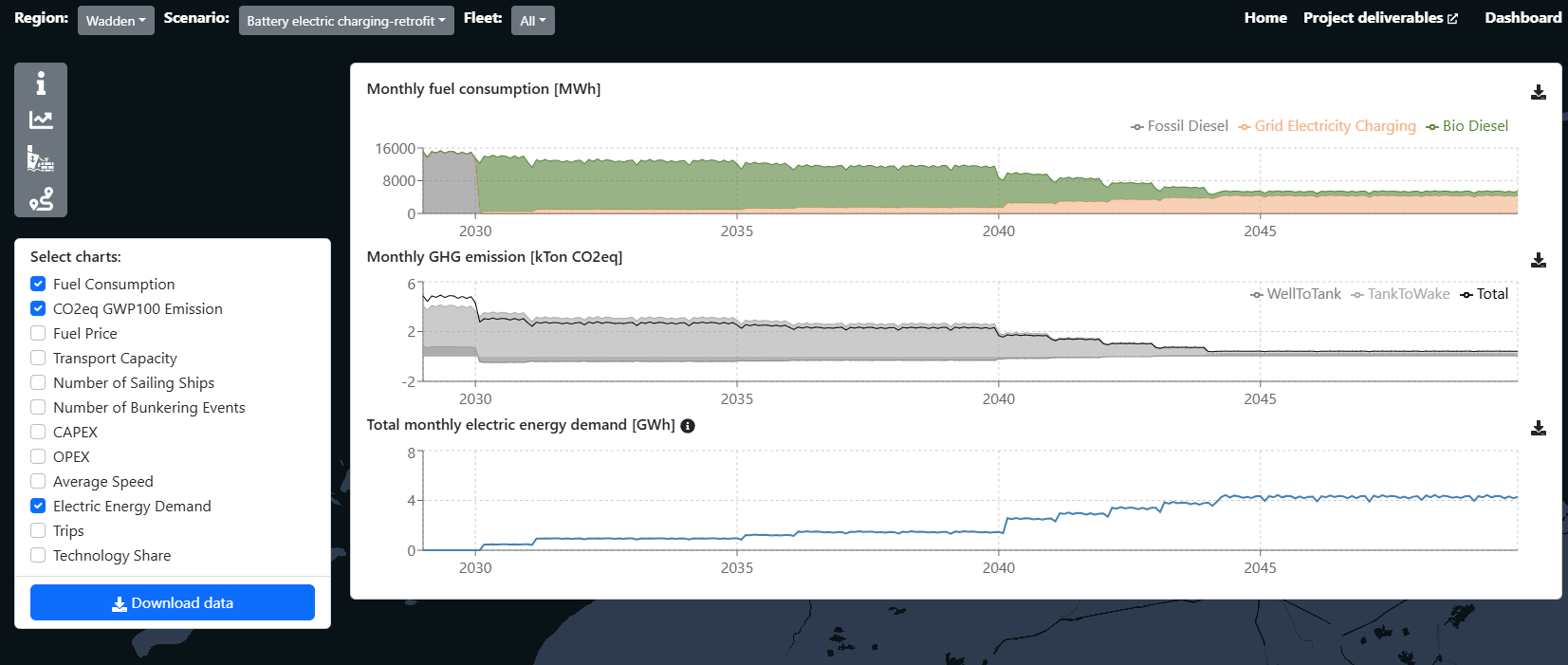
Timeline of the bunkered energy and the reduction in GHG emissions.
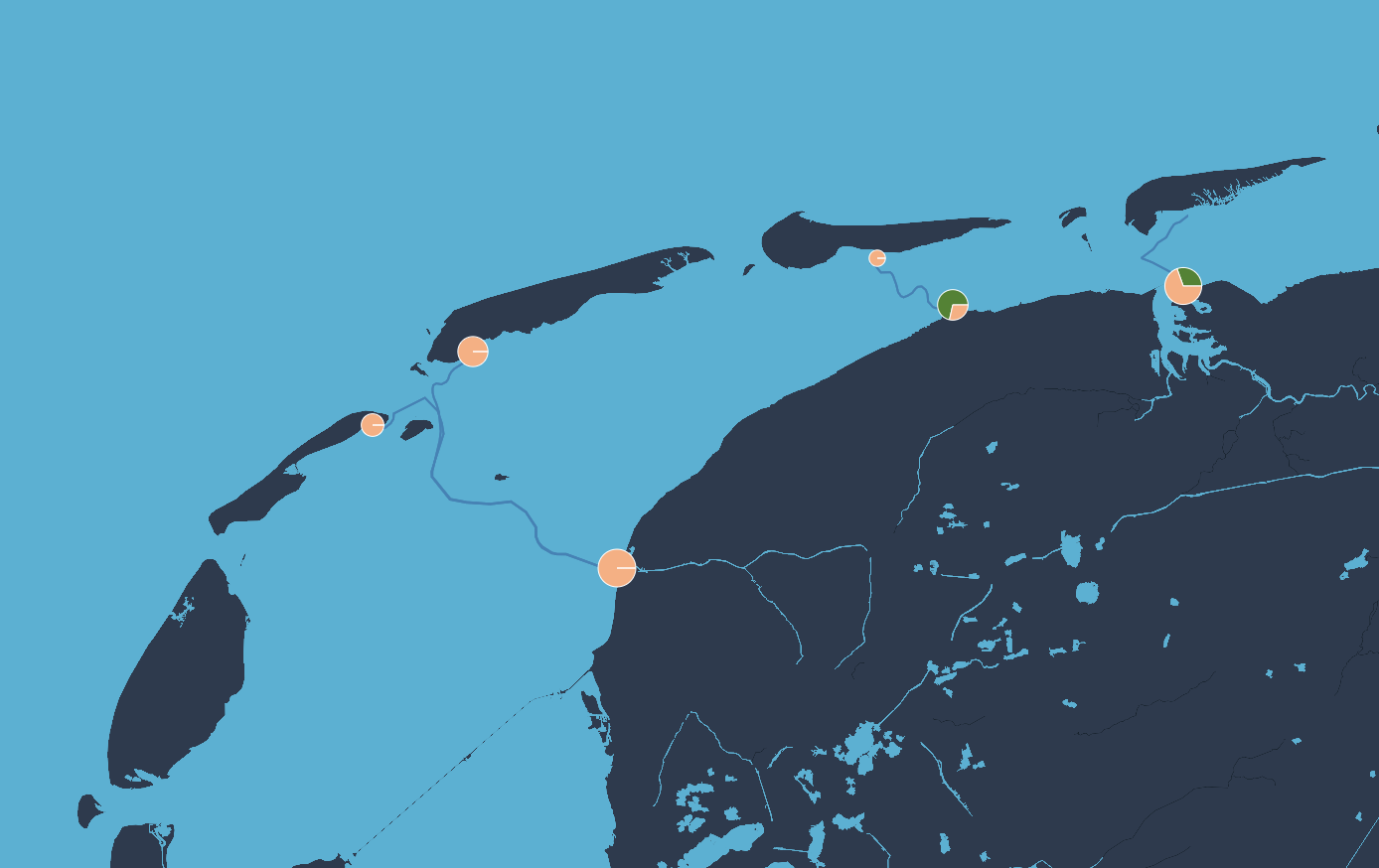
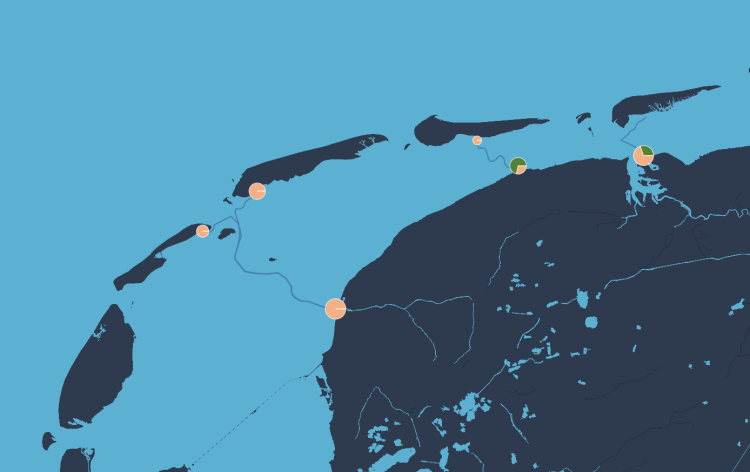
Evolution of the bunkered energy carriers per harbour (animation credits: Michiel Katgert).
Quick-charging system and matching peak power demand
Battery packs large enough to store a full day's energy are too large to install onboard. A more practical approach is to design a power system capable of charging quickly, enough to keep battery depletion manageable over the course of the day, ensuring the vessel’s operational capability.
One of the major challenges for the infrastructure around the ferries is matching peak power demand. It is anticipated that Harlingen will require the largest recharging facilities, with a peak power demand of 58 MW. Across the entire Waddenzee, monthly energy consumption is projected at 4 GWh solely for ferry operations.
In conclusion, the results provided valuable insights into the challenges associated with the proposed electrification strategy and served as a foundation for further discussion.
Feasible decarbonisation pathway but challenges to overcome
Results of the scenario simulations demonstrated that the decarbonisation pathway proposed by the Dutch government is feasible. Simultaneously, the results highlighted criticalities associated with the electrification.
At the vessel level, retrofitting from a conventional diesel engine to a battery propulsion system decreases the ship’s autonomy. With reduced autonomy, ferries must sail slower to consume less energy, leading to longer crossing times between the mainland and the islands and fewer daily departures
Additionally, installing batteries increases the ships’ displacement, which results in higher energy consumption. To counteract this displacement increase, the most effective method is to reduce the number of cars transported. The sizing of the batteries and their charging speeds are also vital in maintaining smooth daily operations. To avoid disrupting the operational profile, ferries can recharge their batteries while in port between crossings.
Government tender for Waddenzee ferries
In November 2025, the Dutch Ministry of Infrastructure and Water Management (Ministerie van Infrastructuur en Waterstaat) published a tender to renew the concessions for the ferries operating on the Waddenzee. During the tender preparation, MARIN used NEEDS to assess the transition scenario proposed by the government towards full electrification.
The tender presents an ambitious plan to reduce CO2eq emissions by converting the entire fleet to a rechargeable battery propulsion system. To support the ship operators, charging stations will be installed at all the harbours except Schiermonnikoog. The electrification of the first route (Lauwersoog to Schiermonnikoog) will occur in 2030, and the remaining routes by 2040. The results of this study are available via an online dashboard.
The initial step in preparing the framework was to gather information on the region and fleet. Data on existing ships were obtained from external sources or from MARIN's internal database. Environmental conditions were calculated using various databases: For example, ERA5 for wind direction and speed and NL Tide – HP33D for sea surface currents. Finally, the conversion to a battery propulsion system was designed utilising MARIN’s sustainable power database.
The NEEDS model simulates a complete waterborne transport system, including energy supply (energy carriers), harbour infrastructure (bunkering availability and speed), waterborne transport (ships, routes, scheduling and capacity), and environmental conditions (wind, waves, current, and water depth). The innovation of NEEDS lies in its ability to launch scenarios that demonstrate how the system changes over time, based on predefined scenarios.


May 2026, no. 147
https://www.marin.nl/jips/needs
https://needs.application.marin.nl
Quick-charging system and matching peak power demand
Battery packs large enough to store a full day's energy are too large to install onboard. A more practical approach is to design a power system capable of charging quickly, enough to keep battery depletion manageable over the course of the day, ensuring the vessel’s operational capability.
One of the major challenges for the infrastructure around the ferries is matching peak power demand. It is anticipated that Harlingen will require the largest recharging facilities, with a peak power demand of 58 MW. Across the entire Waddenzee, monthly energy consumption is projected at 4 GWh solely for ferry operations.
In conclusion, the results provided valuable insights into the challenges associated with the proposed electrification strategy and served as a foundation for further discussion.
Evolution of the bunkered energy carriers per harbour (animation credits: Michiel Katgert).
Feasible decarbonisation pathway but challenges to overcome
Results of the scenario simulations demonstrated that the decarbonisation pathway proposed by the Dutch government is feasible. Simultaneously, the results highlighted criticalities associated with the electrification.
At the vessel level, retrofitting from a conventional diesel engine to a battery propulsion system decreases the ship’s autonomy. With reduced autonomy, ferries must sail slower to consume less energy, leading to longer crossing times between the mainland and the islands and fewer daily departures
Additionally, installing batteries increases the ships’ displacement, which results in higher energy consumption. To counteract this displacement increase, the most effective method is to reduce the number of cars transported. The sizing of the batteries and their charging speeds are also vital in maintaining smooth daily operations. To avoid disrupting the operational profile, ferries can recharge their batteries while in port between crossings.
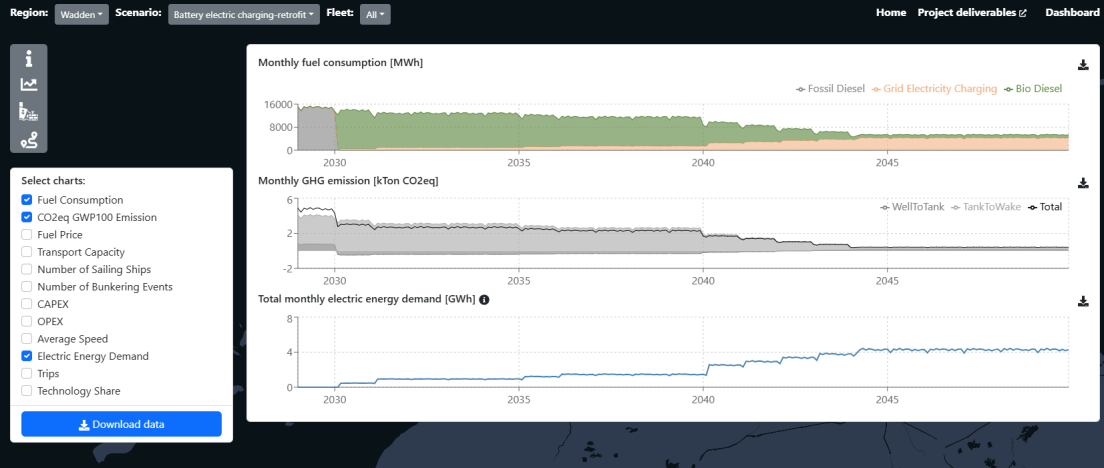
Timeline of the bunkered energy and the reduction in GHG emissions.
CO2 eq emissions distribution per route.
Government tender for Waddenzee ferries
In November 2025, the Dutch Ministry of Infrastructure and Water Management (Ministerie van Infrastructuur en Waterstaat) published a tender to renew the concessions for the ferries operating on the Waddenzee. During the tender preparation, MARIN used NEEDS to assess the transition scenario proposed by the government towards full electrification.
The tender presents an ambitious plan to reduce CO2eq emissions by converting the entire fleet to a rechargeable battery propulsion system. To support the ship operators, charging stations will be installed at all the harbours except Schiermonnikoog. The electrification of the first route (Lauwersoog to Schiermonnikoog) will occur in 2030, and the remaining routes by 2040. The results of this study are available via an online dashboard.
The initial step in preparing the framework was to gather information on the region and fleet. Data on existing ships were obtained from external sources or from MARIN's internal database. Environmental conditions were calculated using various databases: For example, ERA5 for wind direction and speed and NL Tide – HP33D for sea surface currents. Finally, the conversion to a battery propulsion system was designed utilising MARIN’s sustainable power database.
More info
Giancarlo Marelli
Senior Project Manager
The NEEDS model simulates a complete waterborne transport system, including energy supply (energy carriers), harbour infrastructure (bunkering availability and speed), waterborne transport (ships, routes, scheduling and capacity), and environmental conditions (wind, waves, current, and water depth). The innovation of NEEDS lies in its ability to launch scenarios that demonstrate how the system changes over time, based on predefined scenarios.
Retrofitting entire fleets to alternative propulsion systems presents challenges that go far beyond the propulsion system of a single ship.
What efforts are needed to upgrade the onshore electric grid to enable full fleet electrification? How does reducing service speed affect communities living on islands? These are just two of the questions shipowners and government bodies consider when addressing projects with such complex, multidisciplinary issues.


Techno-economic analysis of the Waddenzee
Since 2022, MARIN has been developing NEEDS, a dynamic techno-economic model designed to assist policymakers, shipowners, and national authorities in evaluating the impact of fleet retrofits on the entire waterborne transport system.
Interested? Contact us to discuss your options
Report
Create a MARIN account to stay updated