Human-centred design iterations.

carboncollectors.nl
More info
CONCEPT DEVELOPMENT
Model tests were performed at MARIN’s Seakeeping and Manoeuvring Basin for assessing resistance, motion response, and pin loads of the ATB. The test campaign proved the concept and led to validated numerical models that could be used for further assessment.
CFD simulations were used to assess the influence of specific appendages on the vessel for performance improvement.
Time and frequency domain numerical models were used to further analyse the seakeeping and operational behaviour of the vessel.
This project exemplifies the full cycle of MARIN’s services—from fast-time numerical studies and CFD optimisation, to model testing and real-time simulations.

Comparing multi-fidelity modelling approaches for Articulated Tug Barge motions and pin loads in wave conditions”, 44th International Conference on Ocean, Offshore and Arctic Engineering (OMAE2025), Vancouver, British Colombia, Canada, 2025




“We’ve used the Seakeeping and Manoeuvring Basin. MARIN has done some CFD work for us. We’ve been in a real-time simulator … Every one of these steps helped us to mature and make progress with the design.”

Haije Stigter
Technical Director, Carbon Collectors.
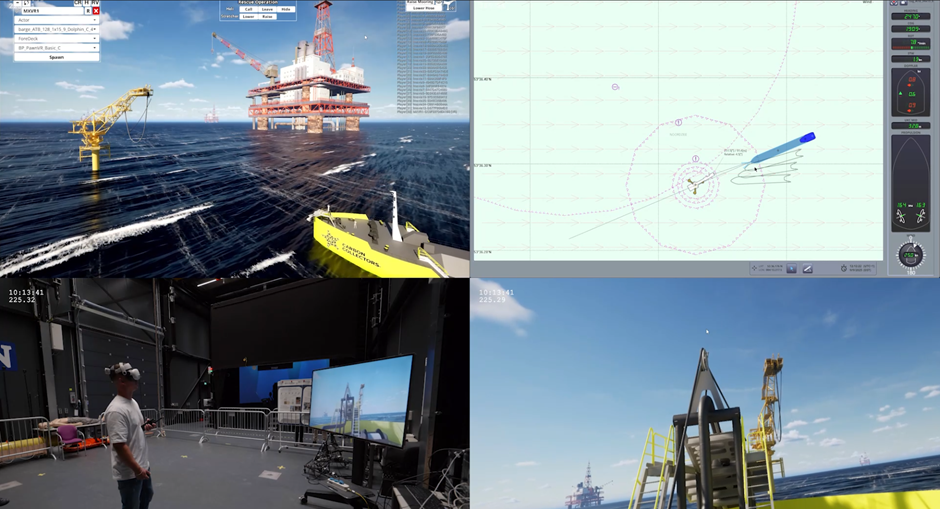
Deck operation from the Maritime eXperience Lab (MX Lab).
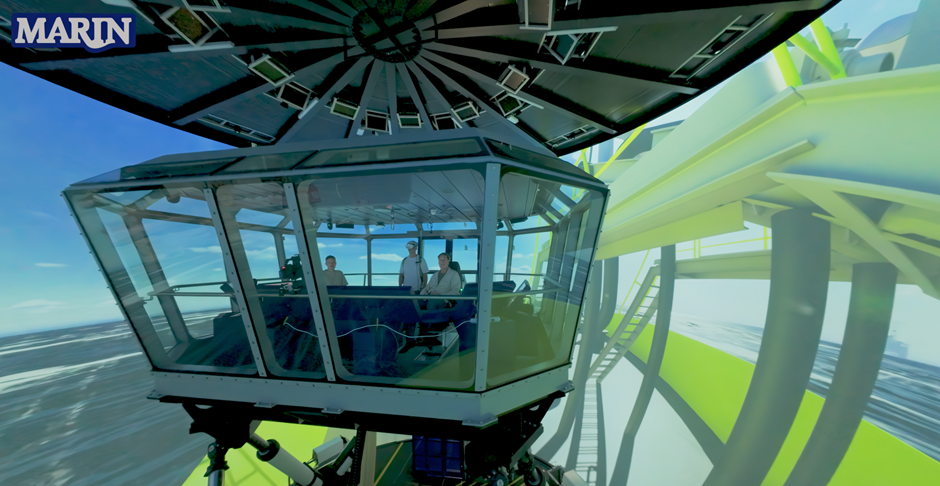
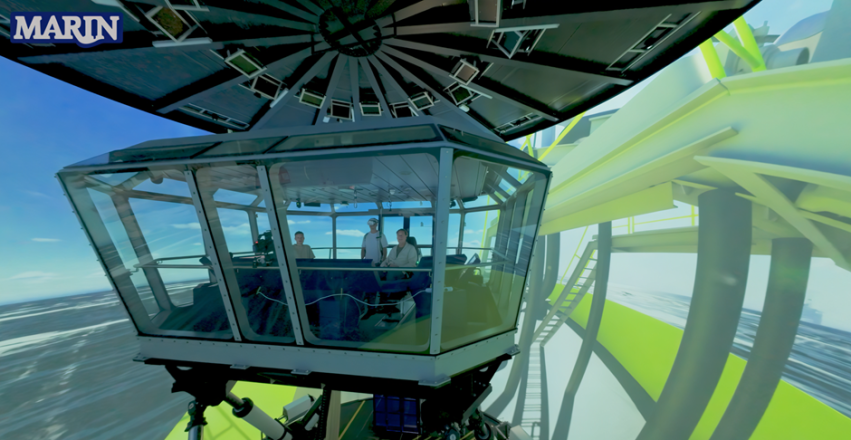
Deck operation from the Large Motion Simulator with the motion base active.
In parallel, a VR setup at MARIN’s Mixed Reality Lab virtually placed a deckhand onboard the bow deck of the barge. The system allowed free movement across the deck to evaluate the practicality of the required deck operations. For selected runs, the VR system was placed on the motion base, adding physical motion cueing to the visual immersion. During these sessions, the vessel bridge was moved to a multi-purpose bridge simulator. In the final simulations, both the captain and the deckhand were positioned at the Large Motion Simulator - one at the bridge and the other on the tug deck via VR - to assess challenges during crew transfer from the tug to the barge.
Create a MARIN account to stay updated

Report
May 2026, no. 147
Interested? Contact us to discuss your options
from concept to operation”. The mixed-reality campaign represented the next step in this iterative process - testing operational limits in a realistic, human-centred setting. By allowing the client to experience and refine operations before the vessel is built, the team reduced risk, increased confidence, and ensured that both vessel and procedures are grounded in operational reality.
Improved focus and safety
Due to some practical limitations in a simulator environment, the physical handling of the hawser and hose lines could not be included in the simulations. Also, noting the absence of wind, sound, and water spray in the simulator, the deckhand said the experience was around 60% realistic. Acknowledging these constraints is itself part of responsible human-centred design. By critically evaluating what the simulator can and cannot reproduce, we can assist in making design decisions that remain grounded in operational reality. Yet, despite the limitations, the deckhand confirmed that such simulations significantly help familiarise crews with procedures, improving focus and safety.
The project demonstrates the value of embedding human validation within iterative design. It also reflects MARIN’s mission “to combine simulation, data and human factors to create greater impact
The simulations closely replicated operational workflows. The captain manoeuvred the ATB into position near the TLU, while the deckhand - visible to the captain as an avatar on the forecastle - provided alignment guidance for the hawser reception. Continuous communication between the bridge and deck was maintained. The deckhand walked through all operational steps, including confirming the hawser and hose line connections. Although lines were not physically grabbed, the procedural sequence of lowering the lines was fully simulated by animations over realistic durations to ensure compliance with expected practice.
A human factor specialist evaluated how the crew felt and whether tasks remained feasible under given conditions. MARIN’s approach aims at collecting feedback from operators early on in the design process to minimise the risk of making design decisions that may not work for the crew. Their feedback remained central throughout the study.
Human-centred design iterations
for operational safety and efficiency
“We’re learning many things during these days and hopefully when the ship gets built, we will already have a lot of experience in this field.”

Captain Rutger Konings
Royal Wagenborg
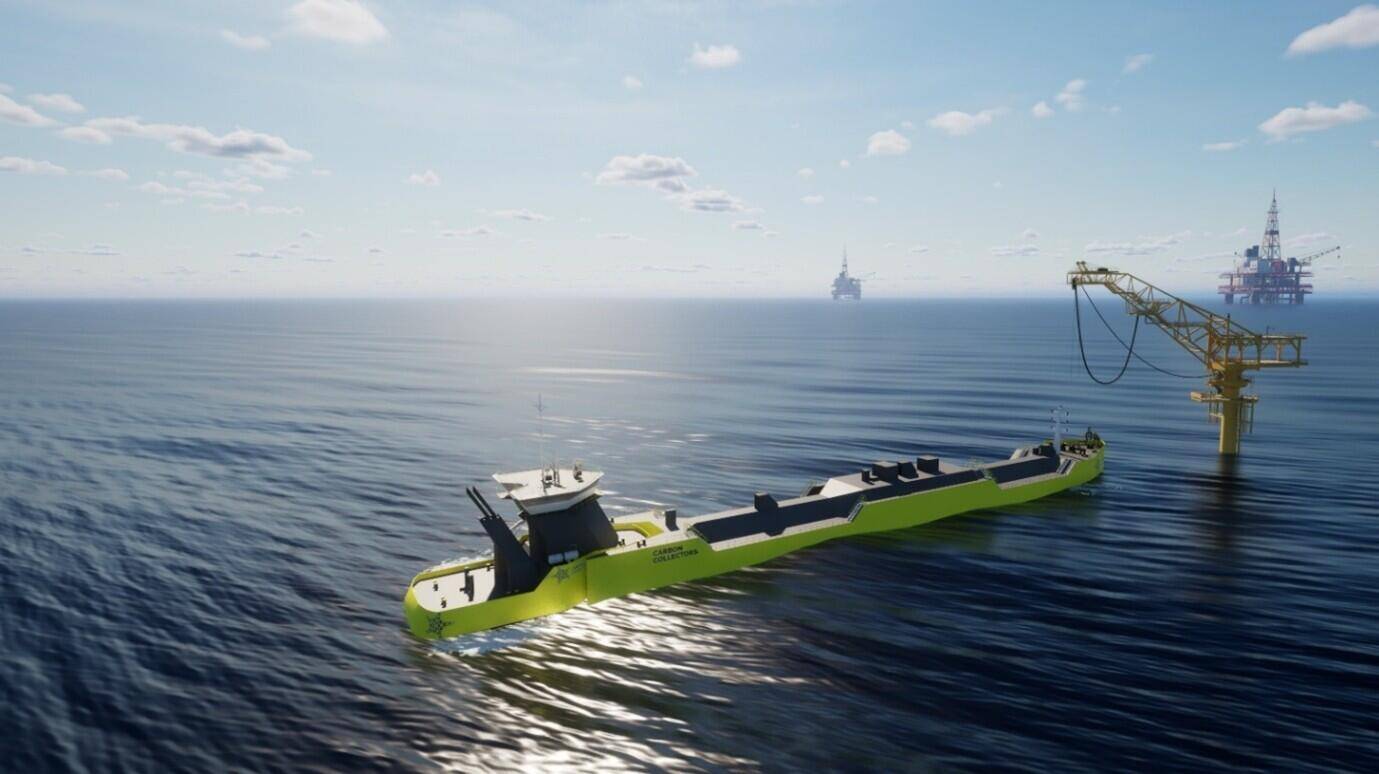
A flyby view of the operation.
In addition, manned deck operations are required on the bow of the barge to connect hawser and hose lines during transfers. In rough weather, these tasks may pose significant safety risks. To validate the concept and determine safe operability limits for the crew, Carbon Collectors approached MARIN to simulate the operation before construction.
Simulations with a Motion Platform and VR
To support the study, the tug bridge was modelled on MARIN’s full mission bridge simulator equipped with a motion base. During the simulations, together with realistic visuals and controls, the tug motions were imposed on the motion base through motion cueing (using acceleration, braking, turning, and tilt). This enabled the captain to assess whether prolonged CO2 pumping operations would be practical in the simulated sea states, considering crew comfort on the bridge. According to Captain Rutger Konings from Royal Wagenborg, the simulator closely replicated real sea conditions in terms of ship handling and motion. He remarked: “If you’re in here for a while, it feels real, like I’m actually at sea on my own vessel.”
MARIN recently demonstrated this approach at the Seven Oceans Simulation centre (SOSc), where virtual reality (VR) and advanced simulator facilities were combined to create a mixed reality environment for operational design validation.
Carbon Collectors
The client, Carbon Collectors, is developing an offshore CO₂ transport and storage concept in which an Articulated Tug Barge (ATB) delivers CO₂ to a Tower Loading Unit (TLU) in the North Sea for injection into a depleted gas field. The relatively small size of the tug and the harsh North Sea environment raised some concerns about tug motion during prolonged operations - particularly in relation to crew safety and comfort.
Humans remain at the heart of complex maritime operations, and their input is essential when shaping safe and practical vessel designs. By integrating crew feedback early in the design process, potential issues can be identified long before construction begins.
Drone view of the Large Motion Simulator with the motion base active.


carboncollectors.nl
Comparing multi-fidelity modelling approaches for Articulated Tug Barge motions and pin loads in wave conditions”, 44th International Conference on Ocean, Offshore and Arctic Engineering (OMAE2025), Vancouver, British Colombia, Canada, 2025
More info
CONCEPT DEVELOPMENT
Model tests were performed at MARIN’s Seakeeping and Manoeuvring Basin for assessing resistance, motion response, and pin loads of the ATB. The test campaign proved the concept and led to validated numerical models that could be used for further assessment.
CFD simulations were used to assess the influence of specific appendages on the vessel for performance improvement.
Time and frequency domain numerical models were used to further analyse the seakeeping and operational behaviour of the vessel.
Deck operation from the Large Motion Simulator with the motion base active.
This project exemplifies the full cycle of MARIN’s services—from fast-time numerical studies and CFD optimisation, to model testing and real-time simulations.
from concept to operation”. The mixed-reality campaign represented the next step in this iterative process - testing operational limits in a realistic, human-centred setting. By allowing the client to experience and refine operations before the vessel is built, the team reduced risk, increased confidence, and ensured that both vessel and procedures are grounded in operational reality.
Improved focus and safety
Due to some practical limitations in a simulator environment, the physical handling of the hawser and hose lines could not be included in the simulations. Also, noting the absence of wind, sound, and water spray in the simulator, the deckhand said the experience was around 60% realistic. Acknowledging these constraints is itself part of responsible human-centred design. By critically evaluating what the simulator can and cannot reproduce, we can assist in making design decisions that remain grounded in operational reality. Yet, despite the limitations, the deckhand confirmed that such simulations significantly help familiarise crews with procedures, improving focus and safety.
The project demonstrates the value of embedding human validation within iterative design. It also reflects MARIN’s mission “to combine simulation, data and human factors to create greater impact
“We’re learning many things during these days and hopefully when the ship gets built, we will already have a lot of experience in this field.”
Captain Rutger Konings
Royal Wagenborg
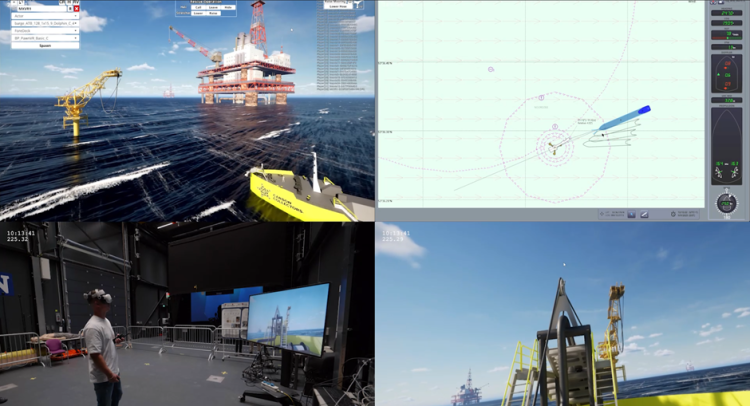
Deck operation from the Maritime eXperience Lab (MX Lab).
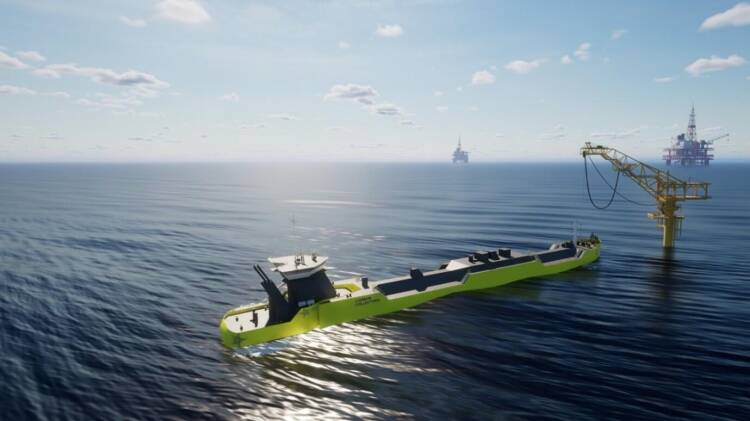
A flyby view of the operation.
“We’ve used the Seakeeping and Manoeuvring Basin. MARIN has done some CFD work for us. We’ve been in a real-time simulator … Every one of these steps helped us to mature and make progress with the design.”
Haije Stigter
Technical Director, Carbon Collectors.
The simulations closely replicated operational workflows. The captain manoeuvred the ATB into position near the TLU, while the deckhand - visible to the captain as an avatar on the forecastle - provided alignment guidance for the hawser reception. Continuous communication between the bridge and deck was maintained. The deckhand walked through all operational steps, including confirming the hawser and hose line connections. Although lines were not physically grabbed, the procedural sequence of lowering the lines was fully simulated by animations over realistic durations to ensure compliance with expected practice.
A human factor specialist evaluated how the crew felt and whether tasks remained feasible under given conditions. MARIN’s approach aims at collecting feedback from operators early on in the design process to minimise the risk of making design decisions that may not work for the crew. Their feedback remained central throughout the study.
Human-centred design iterations.
Interested? Contact us to discuss your options
In parallel, a VR setup at MARIN’s Mixed Reality Lab virtually placed a deckhand onboard the bow deck of the barge. The system allowed free movement across the deck to evaluate the practicality of the required deck operations. For selected runs, the VR system was placed on the motion base, adding physical motion cueing to the visual immersion. During these sessions, the vessel bridge was moved to a multi-purpose bridge simulator. In the final simulations, both the captain and the deckhand were positioned at the Large Motion Simulator - one at the bridge and the other on the tug deck via VR - to assess challenges during crew transfer from the tug to the barge.
Report
Drone view of the Large Motion Simulator with the motion base active.
May 2026, no. 147
MARIN recently demonstrated this approach at the Seven Oceans Simulation centre (SOSc), where virtual reality (VR) and advanced simulator facilities were combined to create a mixed reality environment for operational design validation.
Carbon Collectors
The client, Carbon Collectors, is developing an offshore CO₂ transport and storage concept in which an Articulated Tug Barge (ATB) delivers CO₂ to a Tower Loading Unit (TLU) in the North Sea for injection into a depleted gas field. The relatively small size of the tug and the harsh North Sea environment raised some concerns about tug motion during prolonged operations - particularly in relation to crew safety and comfort.
The µMMS is not only applicable for FOWT, but also for other small floaters and ships. The new measurement system makes it possible to accurately test small vessels, without the unwanted effect of the measurement cables.
For example, this year the Dutch Ministry of Infrastructure and Water Management contracted MARIN to investigate the dynamics that are involved in the capsizing of beam trawlers. The main goal of this project was to investigate the capsize risk in relation to fishing operations and the stability criteria.
Initially, we had planned to make a free sailing model for the tests that connects to the measurement system on the carriage. The combination of a small vessel and the high wave height in the tests resulted in a model weight of less than 100 kg. Given the small model size, low forces can have an impact on the rolling behaviour of the vessel. Therefore, to minimise the impact that the cables can have on the motions of the vessel, we minimised the number of sensors on board to the bare minimum. Additionally, we planned to use thinner cables than normal to reduce the weight even further.
The µMMS became available when we were designing the model. This offered the opportunity to make the model completely wireless and to measure more signals within the budget of the project. Without the measurement wires between the carriage and the model, the test setup was more versatile. No precautions were necessary to avoid interference from the measurement cables.
In addition, manned deck operations are required on the bow of the barge to connect hawser and hose lines during transfers. In rough weather, these tasks may pose significant safety risks. To validate the concept and determine safe operability limits for the crew, Carbon Collectors approached MARIN to simulate the operation before construction.
Simulations with a Motion Platform and VR
To support the study, the tug bridge was modelled on MARIN’s full mission bridge simulator equipped with a motion base. During the simulations, together with realistic visuals and controls, the tug motions were imposed on the motion base through motion cueing (using acceleration, braking, turning, and tilt). This enabled the captain to assess whether prolonged CO2 pumping operations would be practical in the simulated sea states, considering crew comfort on the bridge. According to Captain Rutger Konings from Royal Wagenborg, the simulator closely replicated real sea conditions in terms of ship handling and motion. He remarked: “If you’re in here for a while, it feels real, like I’m actually at sea on my own vessel.”
Humans remain at the heart of complex maritime operations, and their input is essential when shaping safe and practical vessel designs. By integrating crew feedback early in the design process, potential issues can be identified long before construction begins.
Human-centred design iterations
for operational safety and efficiency
Create a MARIN account to stay updated